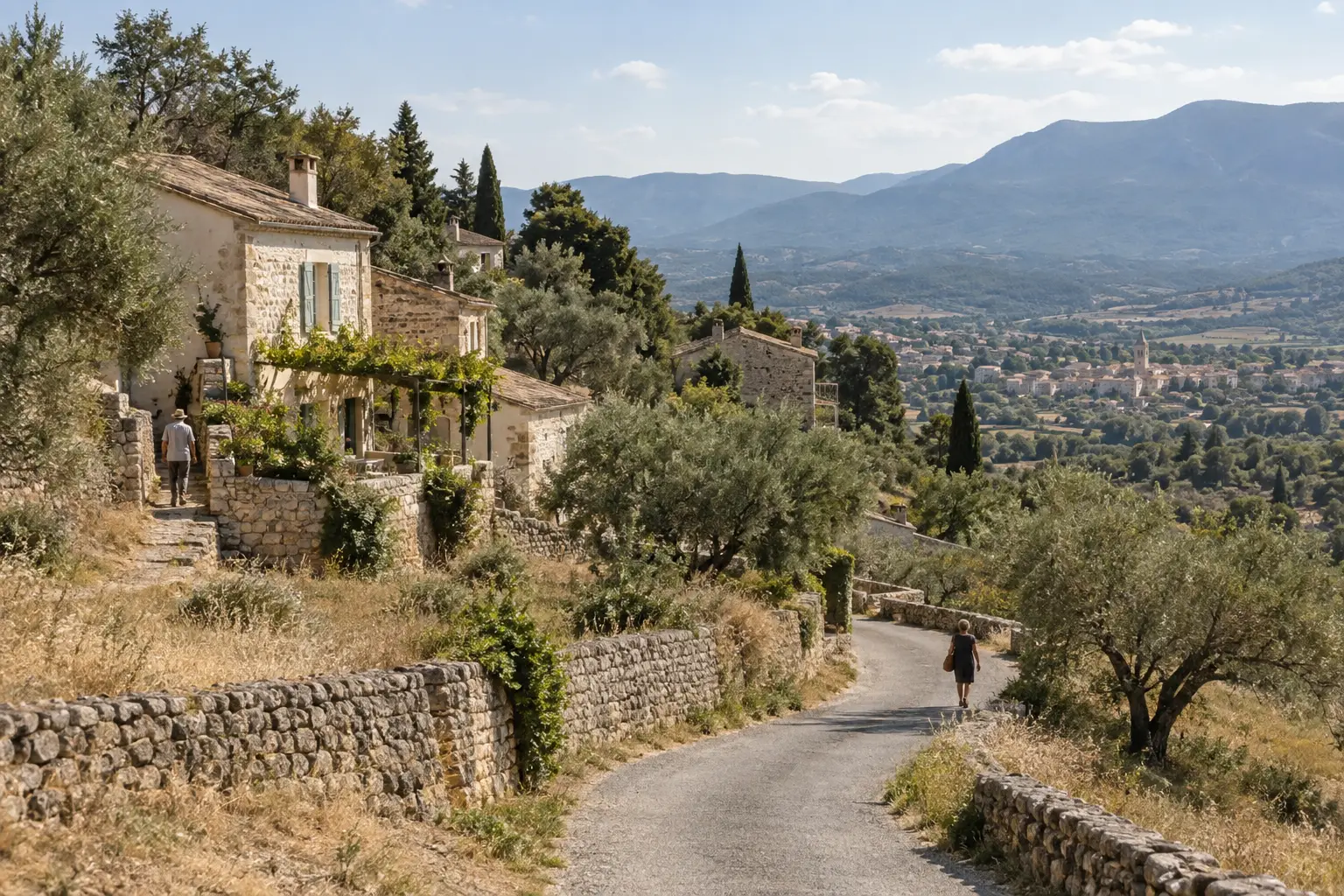
Why a Network of Small Settlements
This material concerns Oasis Project, a concept for physical places within the community. Back to Oasis Project
Oasis is not intended as one village, one hotel or one beautiful location. The core idea of the project is a network of small places in different countries and natural contexts, united by a shared philosophy: calm, beauty, privacy, connection with nature, a quality environment and the possibility to live, work, rest and create in a healthier rhythm.
One Oasis may be by the sea. Another may be in the mountains. A third may be near a city, so that access to healthcare, schools, an airport, shops and business infrastructure remains convenient. In some places, the format may be temporary living and recovery. In others, a place for longer life. Somewhere, a space with active communication. Elsewhere, an almost fully private location for people who value silence and solitude.
It is the network, not a single object, that makes the concept flexible.
Different People, Different Life Scenarios
People have different wishes, rhythms and life circumstances.
Some need a warm climate and the sea. Some feel better in the mountains or forest. Some need to live near an international airport. Some need a school for their children. Some need a legally understandable country for long-term living. Some need a place for a few weeks to recover and work in silence. Some need a home for years.
If we try to fit all of this into one settlement, the concept quickly becomes overloaded and contradictory. One format cannot be ideal for everyone.
A network of small settlements allows us to think differently: not to search for one universal form, but to create different Oasis locations for different life scenarios while preserving the shared spirit of the project.
Small Scale Matters
Oasis should not turn into mass development or a large resort complex. At a small scale, it is easier to preserve silence, privacy, a human feeling of place and a careful attitude toward nature.
A smaller format allows more attention to architecture, landscape, distances between homes, shared spaces, roads, light, noise, views and the feeling of personal space. This is especially important if we are speaking not simply about real estate, but about an environment where a person should feel calm and well.
A mini-settlement can vary in size. In some places, it may be several houses. In others, dozens of units. Elsewhere, a mixed format of detached homes, small villas, apartments, workspaces and shared areas. What matters most is not the exact number of units, but that the place does not lose its human scale.
A Network Gives Freedom of Choice
If Oasis becomes a network, a person will be able to choose not only a specific home, but also a type of environment.
Today they may need a warm island and complete solitude. A year later, a place near a city with business contacts, schools and medical infrastructure. In another period of life, mountains, forest, a cooler climate, a creative environment or more communication.
The network makes it possible not to tie the idea to one country, one climate, one legal system or one lifestyle. It creates space for choice.
In the future, this may give participants and guests a more flexible way to live: not starting from zero each time in a new country, but moving between places where the standards of environment, atmosphere, basic services and project philosophy are already understandable.
Different Countries Help Test Formats
At an early stage, it is impossible to know in advance exactly which Oasis format will be the most viable.
In one country, land and construction may be easier. In another, the climate may be better. In a third, demand from remote professionals may be stronger. In a fourth, the tourist flow may be higher. Somewhere, the legal model is simpler. Somewhere, long-term rental may work better. Elsewhere, a club living format, retreat space, family mini-settlement or hybrid project may be more suitable.
A network allows different hypotheses to be tested gradually, without the need to build an "ideal final version" immediately. The first Oasis can be small and practical. The next ones can take into account mistakes, experience, demand and suggestions from people who have joined the project.
This approach makes the project alive and realistic.
A Shared Philosophy Matters More Than Uniformity
Oasis does not have to look the same in every country. It would be strange to build identical houses by the sea, in the mountains, in the tropics and near a European city.
On the contrary, each place should take into account the local climate, culture, materials, legislation, landscape, infrastructure access and the specific people who will live or rest there.
At the same time, all Oasis locations should have a recognizable foundation:
- proximity to nature;
- a calm and beautiful environment;
- privacy and personal space;
- quality housing;
- good internet and the ability to work;
- thoughtful infrastructure;
- no imposed social model;
- the possibility of communication for those who want it;
- a careful attitude toward the place;
- respect for the person and their freedom of choice.
This philosophy, rather than identical architecture or a single set of rules, should connect different Oasis locations to one another.
A Network Reduces Dependence on One Location
A single project in one country always depends on many factors: legislation, political situation, currency, real estate market, climate, local demand, construction costs, visa rules, infrastructure and the management team.
If the whole idea is tied to one point, any serious risk can stop development.
A network of small settlements makes the project more resilient. If one format does not work, we can study why and try another. If one country becomes difficult, others can be considered. If one scenario turns out to be too expensive or too narrow, the model can be adapted.
This does not mean chaotic expansion. On the contrary, the network should grow gradually and consciously. But the logic of a network itself gives more resilience than betting everything on one object.
Why Not a Big City and Not an Isolated Village
Oasis is somewhere between extremes.
On one side, it is not a big city with noise, density, constant rush and overload. On the other, it is not an isolated village where infrastructure, service, internet, medical accessibility and a professional environment may be lacking.
The idea is to find a balance: to live closer to nature without fully dropping out of modern life. To have privacy without being cut off from the world. To be in a calm place while keeping the ability to work, study, travel, host guests, use services and grow.
Different locations will solve this balance in different ways. This is exactly why the network matters.
Opportunities for Different Participants
A network of small settlements also opens more ways to participate.
Someone may be interested as a future resident or guest. Someone as an investor. Someone as an architect, developer, lawyer, manager, designer, tourism specialist, local partner or person who knows a specific country and can help assess its potential.
If the project is imagined as one settlement, the circle of participation becomes narrow. If it is imagined as a network, there are more entry points, more countries, more formats and more opportunities for people with different experience.
The important thing is that all these forms of participation should not destroy the shared spirit of Oasis, but help it become real.
Where the Network Can Begin
A network does not appear all at once.
First, we need a concept, discussion, people, initial hypotheses and the selection of the most realistic scenarios. Then one or several pilot Oasis locations, possibly very small. After that, an analysis of experience: what works, what does not, what kinds of people come, which formats are in demand, what costs and difficulties arise, and which legal models fit.
Only after that does it make sense to speak about scaling.
In other words, the Oasis network is not a promise to quickly build many settlements. It is a direction of development. A way to think about the project not as a single object, but as a flexible system of places that can gradually appear where natural, human, legal and economic conditions exist.
The Main Point
Oasis is a network of small settlements because the idea itself does not fit into one format.
People are different. Countries are different. Climate, culture, economy, laws and life scenarios are different too. But many people share a similar desire: to live more calmly, beautifully, closer to nature, with more freedom of choice and without the feeling that modern life must necessarily be noisy, cramped and overloaded.
The Oasis network can become a way to search for and create such places gradually: not through dogma, not through a single template, but through shared philosophy, practical experience and the participation of people who feel close to this atmosphere.