What Oasis Is
This material concerns Oasis Project, a concept for physical places within the community. Back to Oasis Project
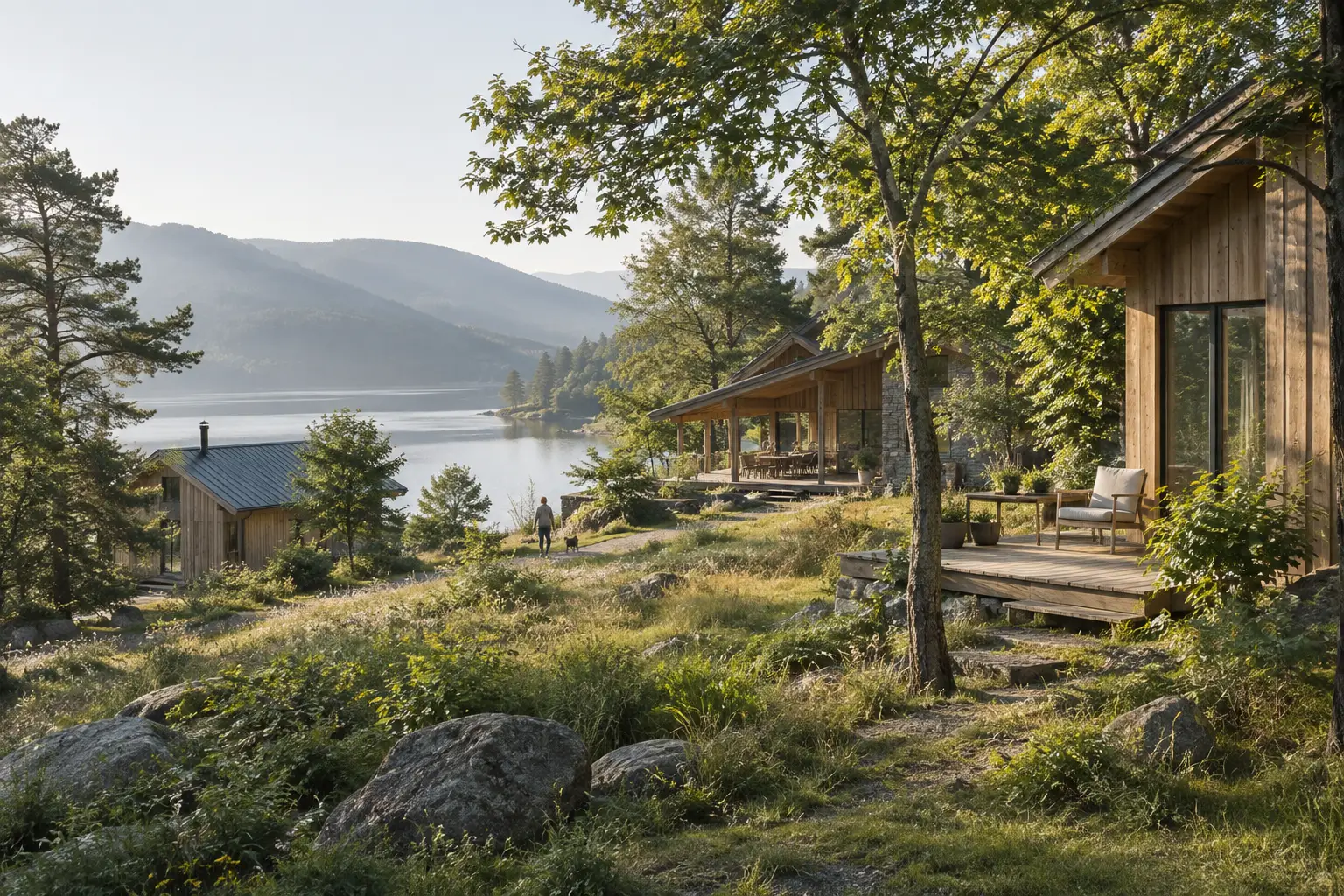
Oasis is a vision for a network of small settlements around the world: calm, beautiful and carefully designed places for living, retreat, privacy, work and creation.
The project is not based on an attempt to build a closed community, a commune or a place "only for our own people". The idea of Oasis is broader than that: to create physical spaces where a person simply feels good. Places with nature nearby, privacy, aesthetics, quality housing, internet, basic infrastructure and the freedom to choose one's own rhythm of life.
For some people, such a place is about being alone, recovering, living by the sea, in the mountains or surrounded by greenery. For others, it is about working remotely in a calm environment. For others, it may be about raising children in a healthier atmosphere. And for some, it is about meeting people with similar values. All of these scenarios can coexist if the place is designed not as a mandatory social model, but as a flexible environment.
The Main Idea
Oasis is not one house, one hotel or one village. It is a network of small settlements that can appear in different countries, climates and formats.
Each location may be different: in one place it could be several houses by the sea, in another a small mountain settlement, and elsewhere a space near a city where people can live, work and rest without losing access to normal infrastructure. But every Oasis should share the same atmosphere: calm, beauty, respect for privacy, connection with nature, a quality environment and the feeling that life here can be more conscious and free.
It is important to me that Oasis is not perceived as a rigid scheme that cannot be changed. Right now it is an open concept. There is a general direction and a spirit of the project, but the specific details can and should be discussed: housing formats, countries, legal models, the amount of shared space, participation scenarios, economics, architecture, rules and services.
If someone feels close to the general idea but sees some elements differently, that is not a problem. Their perspective may be exactly what helps make the project more realistic, more precise and better.
Why Small Settlements
Big cities offer opportunities, but they often take away silence, space, health and the feeling of being connected with nature. Traditional resorts can be good for holidays, but they rarely work for full everyday life and work. Ordinary villages can be beautiful, but often lack the infrastructure, environment and circle of people that make a place practical.
Oasis tries to connect these things differently.
A small settlement is compact enough to preserve a human scale, quietness and a sense of personal space. But it can also be designed well enough to include internet, work areas, services, safety, access to shops, healthcare, transport and other basic needs.
It should not become mass development. And nature should not be used merely as a pretty background. An ideal Oasis is a place where architecture, landscape, infrastructure and lifestyle do not conflict with one another.
Privacy and Communication by Choice
One of the important principles of Oasis is that social life must be voluntary.
The community is needed now for a different reason: to find people who resonate with the idea, discuss it, gather experience, test demand, find potential locations, partners, specialists, investors, future residents or guests. A physical project cannot be created without people.
But this does not mean that future Oasis places should force everyone to live "in community". A completed Oasis should be good both for those who want communication and for those who want silence, privacy and minimal contact with others.
You can take part in events, meet people, discuss ideas and work alongside others. Or you can simply live, rest, work, walk, read, think and explain nothing to anyone. That should be normal.
Who It May Be For
Oasis may resonate with people who feel that the usual formats of life do not quite fit them.
For example, people who work remotely and do not want to be tied to a big city. Entrepreneurs, freelancers, specialists, writers, researchers, investors, families, people in a transitional stage of life, digital nomads, and those looking for a place to recover or live at a calmer pace.
But Oasis is not only about remote work. It is more about an environment where life can be of higher quality: closer to nature, with respect for personal boundaries, without unnecessary noise, but with the possibility of being around people when one wants that.
What Oasis Is Not
It is important to define the boundaries clearly.
Oasis is not a sect, not an ideological movement, not a mandatory commune and not a closed club. There should be no pressure, imposed views, obligatory collective living or requirement to be "part of the group".
Oasis also should not sound like a promise of guaranteed profit. In the future, the project may have different economic models: rental, purchase, shared ownership, partnership or investment scenarios. But all of this requires separate legal, financial and practical work. Right now it is more important to formulate the concept, gather interested people and understand which formats are truly viable.
An Open Concept
At the moment, Oasis is not a finished product. It is a project in formation.
There is a direction: a network of small, beautiful, calm and carefully designed places around the world. There are values: nature, privacy, quality of environment, freedom of choice, respect for the individual, practicality and openness to different life scenarios. And there is a desire to gather people who can help turn this idea into real places.
But many details are still open. And that is normal.
Which countries are best suited for the first Oasis locations? What scale is optimal? How much shared space should there be? Is a unified architectural philosophy needed? What legal models are possible? How can a place be accessible but not mass-market? How can the balance between privacy, economics and atmosphere be preserved?
These questions do not need to be answered alone. This is why community matters now: not as a mandatory social model for the future, but as a way to gather thoughtful and interested people around the idea and gradually bring it closer to implementation.
Why Join Now
Right now, joining means joining the formation of the project, not moving into a finished settlement.
You can follow the development of the idea, discuss materials, suggest locations, share experience, help with architecture, legal questions, finance, development, tourism, product logic, local knowledge or simply offer your perspective as a future resident or guest.
Oasis begins with a simple thought: people need places where they can live more calmly, beautifully, healthily and freely. Not all in the same way. Not according to one rigid model. But with the shared feeling that the environment supports a person rather than suppressing them.
If this atmosphere feels close to you, join the discussion. Perhaps the first real Oasis locations will begin with conversations like these.