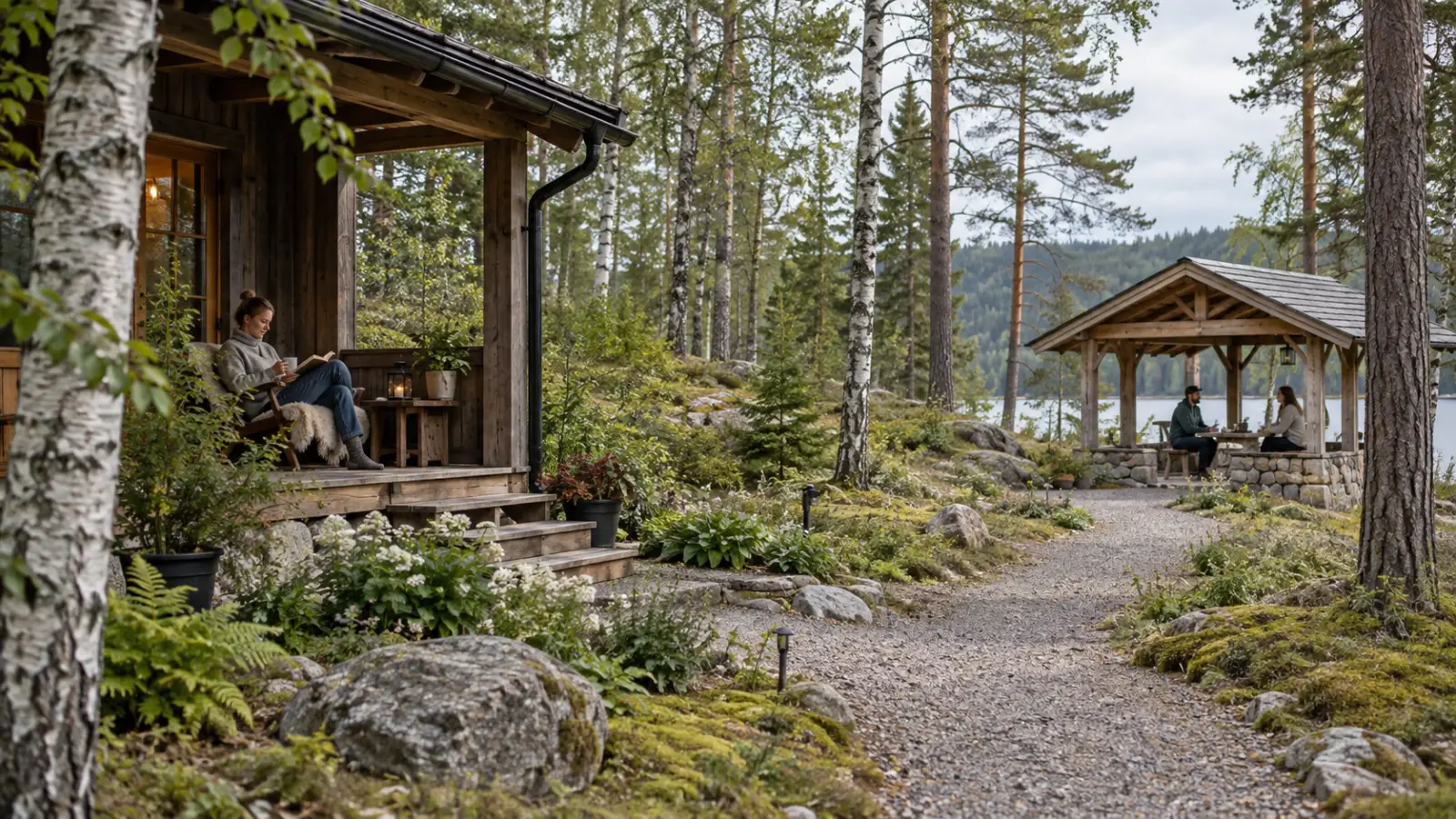
Privacy and Community
This material concerns Oasis Project, a concept for physical places within the community. Back to Oasis Project
One of the most important principles of Oasis is the freedom to choose between privacy and communication.
The project genuinely needs a community. Without people, it is impossible to discuss the idea, test demand, search for locations, gather expertise, find partners and gradually move toward the realization of the first places. But this does not mean that future Oasis locations should turn into a mandatory commune or a space where everyone is required to live a social life.
Oasis is not about pressure and not about a collective model "for everyone". It is about an environment where a person can choose how much contact, participation and communication they need.
Some people want solitude, silence, their own home, a view of nature and minimal interaction with others. Others, on the contrary, want to be near people, discuss ideas, take part in shared activities, work in a common space, meet others and create projects. Both scenarios should be normal.
The Community Is Needed Now for Implementation
At the current stage, the community is first of all a tool for creating the project.
We need to find people who resonate with the idea of Oasis itself. People who understand the value of calm, beautiful and carefully designed places for living, rest, work and recovery. People who feel close to nature, privacy, a quality environment and a freer rhythm of life.
But liking the idea is not enough. For the project to become a physical reality, different roles and forms of participation are needed:
- people who want to follow the development and discuss the concept;
- future residents or guests;
- architects, designers, urbanists and environment specialists;
- lawyers, financiers, developers and managers;
- people with experience in tourism, hospitality, construction and real estate;
- local partners in different countries;
- investors and entrepreneurs;
- those who can suggest locations, contacts, knowledge or a critical perspective.
Such a community does not have to be large. At the first stage, the quality of the dialogue matters more than the number of people: whether people understand the spirit of the project, are ready to think practically and can help clarify the concept.
Community Does Not Mean Mandatory Social Life
It is important not to confuse two things.
There is the community as a group of people who help the project appear. And there is social life inside future locations. These things are connected, but they are not the same.
Participating in the discussion of the project does not mean that, in a completed Oasis, a person will be obliged to attend group meetings, take part in events, live "in public" or constantly interact with neighbors. A future location should offer the possibility to communicate, but not the obligation to communicate.
This is especially important because the idea of Oasis is attractive not only to extroverts or people seeking an active social environment. It may be just as close to those who are tired of noise, density, constant contact and want space for themselves.
Oasis should be good both for communication and for solitude.
Privacy as Part of Environmental Quality
Privacy is not a luxury and not a withdrawal from the world. It is a basic quality of an environment that strongly affects a person's calm.
In Oasis, privacy can be expressed in different ways:
- enough distance between homes or units;
- thoughtful placement of windows, terraces and entrances;
- no feeling that a person is constantly on display;
- the ability to work, rest and live without unnecessary noise;
- clear boundaries between personal and shared space;
- respect for silence;
- no pressure to participate in shared activities;
- the ability to host guests or be alone without explanations.
If privacy is not built into the project from the beginning, it is difficult to add later. That is why it should be one of the criteria when choosing land, designing homes, planning shared zones and setting the rules of life.
Shared Spaces Should Be Useful, Not Imposed
Oasis may include shared zones: a coworking space, a small cafe, a garden, a pool, a workshop, a practice hall, a children's space, a meeting place or a shared kitchen. But their purpose is not to force everyone to be together.
Good shared spaces work when they are genuinely useful and pleasant. A person can come there by choice: to work, meet someone, hold a meeting, exercise, organize a dinner, discuss an idea, watch a film, host a class or simply change the setting.
But if a person does not need this, they should not feel like a "wrong participant" in the project.
Ideally, shared infrastructure should expand freedom of choice, not replace personal space.
Different Oasis Locations Can Have Different Levels of Sociality
Because Oasis is conceived as a network, different places can have different characters.
One Oasis may be almost a retreat space: silence, private homes, few events, with an emphasis on recovery and solitude.
Another may be more work-oriented and entrepreneurial: coworking, meetings, discussions, project launches and exchange of experience.
A third may be family-oriented: children, a safe environment, educational activities, a calm rhythm and infrastructure for longer living.
A fourth may be closer to a creative residence: studios, workshops, events and shared projects.
The main thing is that expectations should be honestly stated in advance. Then a person can choose the Oasis that suits them, instead of entering an environment that requires a lifestyle that does not fit them.
No Sect, Closed Club or Ideological Pressure
It is very important that Oasis does not sound or feel like a sect, a closed club or an ideological movement.
The project may have a philosophy, but it should not have dogma. It may have a community, but it should not have pressure. It may have a shared atmosphere, but it should not require mandatory sameness.
People may have different views, habits, levels of participation and lifestyles. They do not need to be brought into one template. It is enough that they respect the space, other people's boundaries, nature, the rules of a specific place and the general spirit of a calm, quality environment.
Oasis should not require a person to "stop being themselves" in order to be part of the project.
Boundaries and Rules Are Still Needed
Voluntary communication does not mean the absence of rules.
On the contrary, for privacy and freedom of choice to work, clear boundaries are needed. For example: quiet hours, rules for using shared spaces, attitudes toward guests, animals, children, events, rentals, noise, safety, cleanliness, natural territory and the local community around Oasis.
Rules should protect the atmosphere of the place, not control people's lives.
Their task is to make sure that a person who came for silence can actually receive silence. And that a person who wants communication can find it in the right space and format, without violating other people's personal boundaries.
How This Can Work in Practice
Practically, this can mean several levels of participation.
The first level is simply living or resting in Oasis. Using one's home or unit, nature, infrastructure and services. Communication can be minimal.
The second level is using shared spaces: coworking, cafe, garden, sports or creative zones. This already creates a soft presence in the environment, but does not require active participation.
The third level is taking part in events, meetings, discussions, shared projects and local initiatives.
The fourth level is helping develop the project itself: suggesting ideas, participating in organization, investing, bringing expertise, creating new formats and helping launch other Oasis locations.
A person can be at any level and change it over time. Today they need silence. In a month, communication. In a year, participation in development. Or the other way around. This is normal.
Why Balance Matters More Than Extremes
If the focus is only on privacy, Oasis may become simply beautiful real estate without a living idea and without people who help the project develop.
If the focus is only on community, there is a risk of creating an intrusive social environment that will push away those who need silence and personal space.
That is why balance matters.
Community helps the project appear and develop. Privacy makes future places truly suitable for living and recovery. Shared spaces create the possibility to meet. Personal spaces create the possibility to be oneself.
Oasis should connect these elements without coercion.
The Main Point
Oasis needs a community in order to become real. But completed Oasis places should not impose mandatory social life on people.
The community now is a way to gather people, ideas, experience, expertise and resources for the realization of the project. Privacy in future places is one of the key qualities of the environment.
A good Oasis should allow a person to choose for themselves: to be alone, to be near people, to take part in events, to help the project or simply to live in a calm and beautiful place.
It is this freedom of choice that makes the concept healthy. It separates Oasis from a commune, a sect, a closed club or another project where a person is offered not an environment for life, but a ready-made model of behavior.